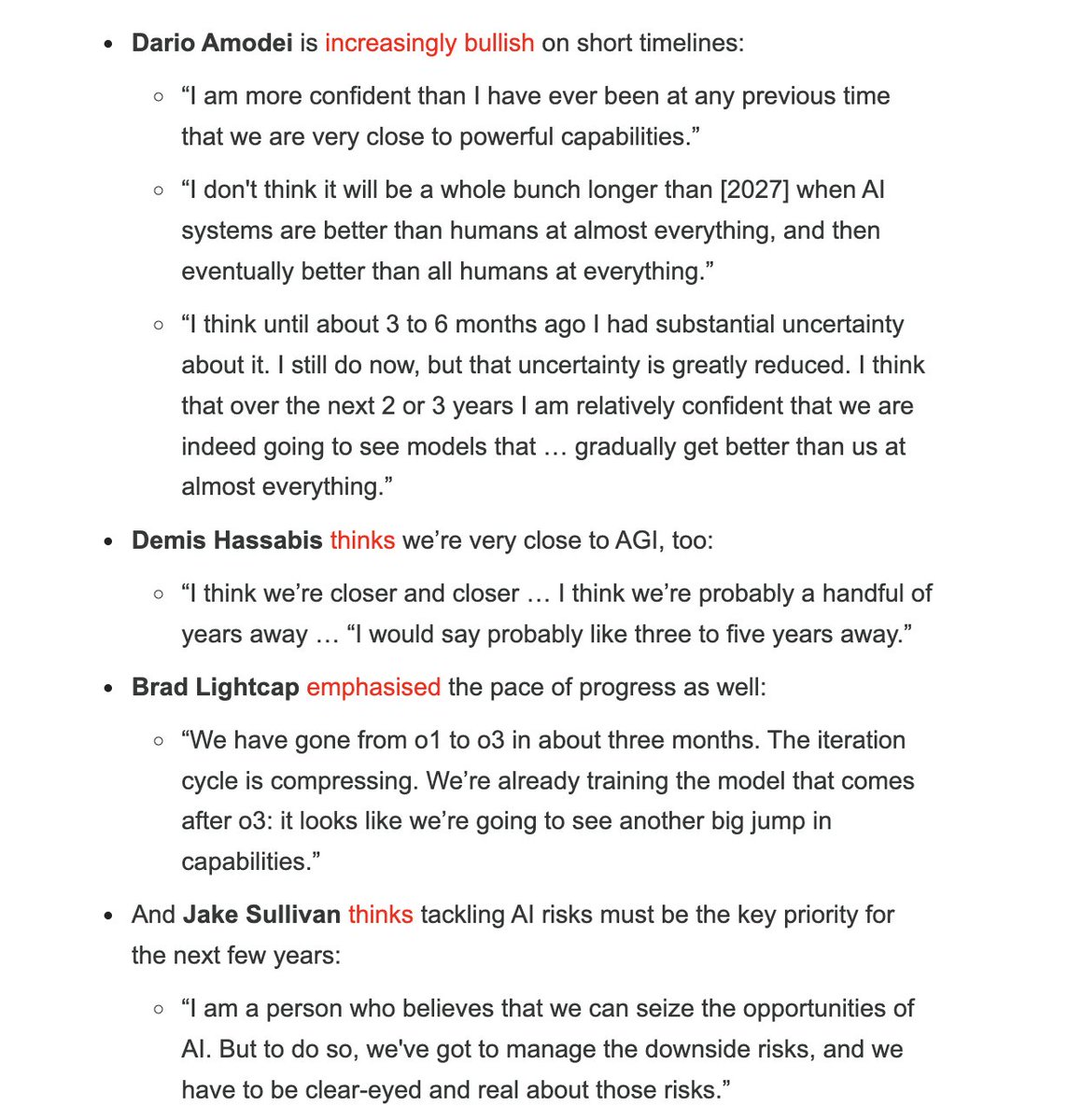
Noam Brown on feeling the AGI
Correct, except that competitive coders will be feeling it this year, if they aren't already.
Ellsberg to Kissenger, on security clearance
“Henry, there’s something I would like to tell you, for what it’s worth, something I wish I had been told years ago. You’ve been a consultant for a long time, and you’ve dealt a great deal with top secret information. But you’re about to receive a whole slew of special clearances, maybe fifteen or twenty of them, that are higher than top secret.
“I’ve had a number of these myself, and I’ve known other people who have just acquired them, and I have a pretty good sense of what the effects of receiving these clearances are on a person who didn’t previously know they even existed. And the effects of reading the information that they will make available to you.
“First, you’ll be exhilarated by some of this new information, and by having it all — so much! incredible! — suddenly available to you. But second, almost as fast, you will feel like a fool for having studied, written, talked about these subjects, criticized and analyzed decisions made by presidents for years without having known of the existence of all this information, which presidents and others had and you didn’t, and which must have influenced their decisions in ways you couldn’t even guess. In particular, you’ll feel foolish for having literally rubbed shoulders for over a decade with some officials and consultants who did have access to all this information you didn’t know about and didn’t know they had, and you’ll be stunned that they kept that secret from you so well.
“You will feel like a fool, and that will last for about two weeks. Then, after you’ve started reading all this daily intelligence input and become used to using what amounts to whole libraries of hidden information, which is much more closely held than mere top secret data, you will forget there ever was a time when you didn’t have it, and you’ll be aware only of the fact that you have it now and most others don’t….and that all those other people are fools.
“Over a longer period of time — not too long, but a matter of two or three years — you’ll eventually become aware of the limitations of this information. There is a great deal that it doesn’t tell you, it’s often inaccurate, and it can lead you astray just as much as the New York Times can. But that takes a while to learn.
“In the meantime it will have become very hard for you to learn from anybody who doesn’t have these clearances. Because you’ll be thinking as you listen to them: ‘What would this man be telling me if he knew what I know? Would he be giving me the same advice, or would it totally change his predictions and recommendations?’ And that mental exercise is so torturous that after a while you give it up and just stop listening. I’ve seen this with my superiors, my colleagues….and with myself.
“You will deal with a person who doesn’t have those clearances only from the point of view of what you want him to believe and what impression you want him to go away with, since you’ll have to lie carefully to him about what you know. In effect, you will have to manipulate him. You’ll give up trying to assess what he has to say. The danger is, you’ll become something like a moron. You’ll become incapable of learning from most people in the world, no matter how much experience they may have in their particular areas that may be much greater than yours.”
….Kissinger hadn’t interrupted this long warning. As I’ve said, he could be a good listener, and he listened soberly. He seemed to understand that it was heartfelt, and he didn’t take it as patronizing, as I’d feared. But I knew it was too soon for him to appreciate fully what I was saying. He didn’t have the clearances yet.
Airbus: upgrading their software UI from "crappy" to "best practice" helped 4x the pace of A350 manufacturing
These are all sort of basic software things, but you’ve seen how crappy enterprise software can be just deploying these ‘best practice’ UIs to the real world is insanely powerful. This ended up helping to drive the A350 manufacturing surge and successfully 4x’ing the pace of manufacturing while keeping Airbus’s high standards of quality.
OpenAI o1 solves a cipher
The prompt:
oyfjdnisdr rtqwainr acxz mynzbhhx -> Think step by step
Use the example above to decode:
oyekaijzdf aaptcg suaokybhai ouow aqht mynznvaatzacdfoulxxz
The chain of thought:
First, what is going on here?
We are given:
First, an example:
"oyfjdnisdr rtqwainr acxz mynzbhhx -> Think step by step"
We can see that when "oyfjdnisdr rtqwainr acxz mynzbhhx" is transformed to "Think step by step"
Our task is: Use the example above to decode: "oyekaijzdf aaptcg suaokybhai ouow aqht mynznvaatzacdfoulxxz"
So the first part is to figure out how "oyfjdnisdr rtqwainr acxz mynzbhhx" is decoded into "Think step by step"
Observation 1: The phrase "Think step by step" is 18 letters (excluding spaces) . Let's count the letters.
Similarly, let's count the letters in "oyfjdnisdr rtqwainr acxz mynzbhhx"
Original Ciphertext:
oyfjdnisdr rtqwainr acxz mynzbhhx
Plaintext:
Think step by step
First, break down the letters:
Ciphertext letters: o y f j d n i s d r r t q w a i n r a c x z m y n z b h h x
Total letters: Let's count the letters in the ciphertext.
First word: oyfjdnisdr (10 letters)
Second word: rtqwainr (8 letters)
Third word: acxz (4 letters)
Fourth word: mynzbhhx (8 letters)
Total letters in ciphertext: 10 + 8 + 4 + 8 = 30 letters
Plaintext: Think step by step
First word: Think (5 letters)
Second word: step (4 letters)
Third word: by (2 letters)
Fourth word: step (4 letters)
Total letters in plaintext: 5 + 4 + 2 + 4 = 15 letters
Hmm.
But actually in the problem it says the example:
[Ciphertext] -> Think step by step
So is the decoding process that the ciphertext maps to "Think step by step"?
Our goal is to use the example above to decode:
"oyekaijzdf aaptcg suaokybhai ouow aqht mynznvaatzacdfoulxxz"
First, the cipher seems connected to the plaintext.
Given the time constraints, perhaps the easiest way is to try to see patterns.
Option 1: Try to find mapping from letters to letters.
Do any letters match?
First, let's write down the ciphertext and plaintext letters on top of each other.
Ciphertext: o y f j d n i s d r r t q w a i n r a c x z m y n z b h h x
Plaintext: T h i n k s t e p b y s t e p
Wait a minute.
I think maybe there is an anagram or substitution cipher here.
Alternatively, I think that we can notice that each group of ciphertext corresponds to a plaintext word.
Check the number of letters.
First ciphertext word: oyfjdnisdr (10 letters)
First plaintext word: Think (5 letters)
Hmm.
Second ciphertext word: rtqwainr (8 letters)
Second plaintext word: step (4 letters)
Third ciphertext word: acxz (4 letters)
Third plaintext word: by (2 letters)
Fourth ciphertext word: mynzbhhx (8 letters)
Fourth plaintext word: step (4 letters)
Interesting.
It seems that the ciphertext words are exactly twice as long as the plaintext words.
(10 vs 5, 8 vs 4, 4 vs 2, 8 vs 4)
Idea: Maybe we need to take every other letter or rebuild the plaintext from the ciphertext accordingly.
Let's test this theory.
If we take every other letter from the ciphertext words, maybe we'll get the plaintext.
Let's try this for the first word:
Ciphertext word: o y f j d n i s d r (10 letters)
Alternate letters:
First letters (positions 1,3,5,7,9): o f d i d
Second letters (positions 2,4,6,8,10): y j n s r
Wait: Let's try taking every second letter or first letter.
Option 1: Take the odd positions:
Positions: 1 3 5 7 9
Letters: o f d i d
Plaintext word is "Think", letters are T h i n k
Hmm.
Perhaps we can map letters:
o f d i d --> Think
Not directly
Option 2: Try mapping as per an assigned code: perhaps columns of letters?
Alternatively, perhaps the cipher is more complex.
Alternatively, notice that "oyfjdnisdr" has 10 letters and "Think" has 5 letters.
What if each plaintext letter is being represented by two ciphertext letters?
Similarly for other words.
Suppose that each plaintext letter corresponds to pair of letters in the ciphertext.
Meaning that the first two letters of ciphertext map to the first plaintext letter, and so on.
So for the first word, partition the ciphertext letters into pairs:
oy fj dn is dr
Corresponding to plaintext letters T h i n k
So we can attempt to map:
oy -> T
fj -> h
dn -> i
is -> n
dr -> k
If this is the mapping, perhaps each pair of letters maps to one plaintext letter.
Similarly for other words.
Let's test this mapping.
Is there a consistent mapping from pairs to letters?
Let's make a table of pairs and corresponding letters.
First, make the pairs from the first word and their corresponding plaintext letters:
Ciphertext Pairs -> Plaintext Letter
oy -> T
fj -> h
dn -> i
is -> n
dr -> k
Now, what's the mapping from "oy" to 'T'?
Is there a way to map 'oy' to 'T'?
Similarly for others.
One possible way is that 'oy' represents 'T'.
But how?
Option 1: Sum of the letters.
Convert letters to numbers (A=1, B=2, ..., Z=26)
So let's try to get to 'T' from 'o' and 'y'
o = 15
y = 25
Sum: 15 +25 = 40
But 'T' is 20.
Alternatively, perhaps subtract: 25 -15 = 10.
No.
Alternatively, perhaps combine the numbers in some way.
Alternatively, think about their positions in the alphabet.
Alternatively, perhaps the letters are encrypted via a code.
Alternatively, perhaps if we overlay the word 'Think' over the cipher pairs 'oy', 'fj', etc., the cipher is formed by substituting each plaintext letter with two letters.
Alternatively, perhaps consider the 'original' letters.
Let's look at the letters between the word "Think" and "oyfjdnisdr"
Perhaps we can spot that "oyfjdnisdr" is an anagram for "Thinkfiles"?
But that seems unlikely.
Alternatively, think of the pairs.
Suppose we assign numbers to letters: a=1, b=2, ..., z=26
Consider the numbers in 'oy':
o = 15
y = 25
Add them: 15 + 25 = 40
Now, for 'T' we have:
'T' is number 20
What if we take the sum of the cipher pair mod 26.
15 +25 = 40
Then 40 mod 26 = 14
14 corresponds to 'N'
Doesn't match.
Alternatively, see if the cipher pairs correspond to something else.
Alternatively, perhaps the pair 'oy' corresponds to 'T' via key.
Alternatively, perhaps it's as simple as 'oy' is 'T'.
But 'o' corresponds to 'T', subtracting 'o' ASCII code from 'T'.
Now, let's think in terms of symmetric letters.
Alternatively, perhaps we can spot that the letters correspond to the first letters of words.
But perhaps an easier way is to look at the word positions.
Alternatively, perhaps we can see that the ciphertext letters are offsets from the plaintext letters.
So let's try to map the pairs to the plaintext letters.
First pair 'oy' and plaintext letter 'T'
Letter 'o' is 15, 'T' is 20
Letter 'o' + 5 = 'T' (15 +5=20)
But 'y' is 25, which is 5 letters after 'T' (20 +5=25)
Interesting, seems that 'o' +5 = 'T'
Similarly, 'y' +1 = 'Z', which is not 'T'.
Alternatively, maybe the average of the two letters corresponds to 'T'
(15 +25)/2 =20, which is 'T'
Wait a minute, that seems promising.
First pair: 'o' (15) + 'y' (25) = 40
40 /2 =20
20 corresponds to 'T'
So perhaps the average of the letters in the pair corresponds to the plaintext letter.
Let's check this with the second pair.
Second pair: 'fj' corresponding to 'h'
Letters 'f'=6, 'j'=10
Sum: 6+10=16
Average:16/2=8
8 corresponds to 'h' (since 'h' is 8)
Success!
Third pair: 'dn' to 'i'
'd'=4, 'n'=14
Sum:4+14=18
Average:18/2=9
9 corresponds to 'i'(9='i')
But 'i' is 9, so that seems off by 1.
So perhaps we need to think carefully about letters.
Wait, 18/2=9, 9 corresponds to 'I'
So this works.
Fourth pair: 'is' corresponding to 'n'
'i'=9, 's'=19
Sum:9+19=28
Average:28/2=14
14 corresponds to 'n'(14='N')
Yes!
Fifth pair: 'dr' corresponds to 'k'
'd'=4, 'r'=18
Sum:4+18=22
Average:22/2=11
11 corresponds to 'k'(11='K')
Perfect!
So our code is: For each pair, sum their numeric values, divide by 2, get the corresponding letter.
Alternatively, the average of the numeric values of the letters corresponds to the plaintext letter.
This seems to be a valid method.
Now let's test this with the other words.
Second word ciphertext: rtqwainr
Ciphertext pairs:
rt -> s
qw -> ?
ai -> ?
nr -> ?
Corresponding to plaintext letters 's', 't', 'e', 'p'
So let's take the pairs:
1. 'rt' corresponds to 's'
r=18, t=20
Sum:38
Average:19
19 corresponds to 's' (19='S')
Good
2. 'qw' corresponds to 't'
q=17, w=23
Sum:17+23=40
Average:20
20 corresponds to 't' (20='T')
Good
3. 'ai' corresponds to 'e'
a=1, i=9
Sum:10
Average:5
5 corresponds to 'e' (5='E')
Good
4. 'nr' corresponds to 'p'
n=14, r=18
Sum:32
Average:16
16 corresponds to 'p' (16='P')
Perfect!
Third word: acxz (4 letters)
Plaintext word: 'by' (2 letters)
Ciphertext pairs:
a c
x z
Plaintext letters: 'b', 'y'
First pair: 'a', 'c'
a=1, c=3
Sum:4
Average:2
2 corresponds to 'b'(2='B')
Second pair: 'x' and 'z'
x=24, z=26
Sum:50
Average:25
25 corresponds to 'y'(25='Y')
Yes!
Fourth word: mynzbhhx (8 letters)
Plaintext word: 'step' (4 letters)
Ciphertext pairs:
my
nz
bh
hx
Plaintext letters 's','t','e','p'
First pair 'm','y'
m=13, y=25
Sum:38
Average:19
19 corresponds to 's'(19='S')
Second pair: 'n','z'
n=14, z=26
Sum: 40
Average:20
20='t'
Third pair: 'b','h'
b=2, h=8
Sum:10
Average:5
5='e'
Fourth pair: 'h','x'
h=8, x=24
Sum:32
Average:16
16='p'
Got it!
Now, given this, we can decode the given message.
Ciphertext to decode:
"oyekaijzdf aaptcg suaokybhai ouow aqht mynznvaatzacdfoulxxz"
First, we need to divide into words.
Given that the ciphertext in the example had words of length:
-10 letters (5 pairs)
-8 letters (4 pairs)
-4 letters (2 pairs)
-8 letters (4 pairs)
Transported to plaintext words of:
-5 letters
-4 letters
-2 letters
-4 letters
So perhaps in our supplied ciphertext, we need to divide the letters into words accordingly.
Ciphertext: o y e k a i j z d f a a p t c g s u a o k y b h a i o u o w a q h t m y n z n v a a t z a c d f o u l x x z
First, let's write the letters in order:
1) oyekaijzdf (10 letters) -> word of 5 letters
2) aaptcg (6 letters) -> word of 3 letters
3) suaokybhai (10 letters) -> word of 5 letters
4) ouow (4 letters) -> word of 2 letters
5) aqht (4 letters) -> word of 2 letters
6) mynznvaatzacdfoulxxz (22 letters) -> word of 11 letters
Totals:
So the letters are:
First word: oyekaijzdf (10 letters = 5 pairs)
Second word: aaptcg (6 letters=3 pairs)
Third word: suaokybhai (10 letters=5 pairs)
Fourth word: ouow (4 letters=2 pairs)
Fifth word: aqht (4 letters=2 pairs)
Sixth word: mynznvaatzacdfoulxxz (22 letters=11 pairs)
So we can suppose that the plaintext words have lengths:
1) 5 letters
2) 3 letters
3) 5 letters
4) 2 letters
5) 2 letters
6)11 letters
Now we can proceed to decode.
First word: oyekaijzdf
Divide into pairs:
oy
ek
ai
jz
df
So we can find the plaintext letters by averaging the numeric values of the letters in each pair.
First pair: 'o','y'
o=15, y=25
Sum=40
Average=20
20='T'
Second pair: 'e','k'
e=5, k=11
Sum=16
Average=8
8='H'
Third pair: 'a','i'
a=1, i=9
Sum=10
Average=5
5='E'
Fourth pair: 'j','z'
j=10, z=26
Sum=36
Average=18
18='R'
Fifth pair: 'd','f'
d=4, f=6
Sum=10
Average=5
5='E'
So the first word is 'T','H','E','R','E'
So 'THERE'
Second word: aaptcg
Pairs:
aa
pt
cg
First pair: 'a','a'
a=1, a=1
Sum=2
Average=1
1='A'
Second pair: 'p','t'
p=16, t=20
Sum=36
Average=18
18='R'
Third pair: 'c','g'
c=3, g=7
Sum=10
Average=5
5='E'
So second word: 'A','R','E'
Third word: suaokybhai
Pairs:
su
ao
ky
bh
ai
First pair: s=19, u=21
Sum=40, Average=20
20='T'
Second pair: a=1, o=15
Sum=16, Average=8
8='H'
Third pair: k=11, y=25
Sum=36, Average=18
18='R'
Fourth pair: b=2, h=8
Sum=10, Average=5
5='E'
Fifth pair: a=1, i=9
Sum=10, Average=5
5='E'
Third word: 'T','H','R','E','E'
Fourth word: ouow
Pairs: ou, ow
First pair: o=15, u=21
Sum=36, Average=18
18='R'
Second pair: o=15, w=23
Sum=38, Average=19
19='S'
Fourth word: 'R','S'
Fifth word: aqht
Pairs: a q, h t
First pair: a=1, q=17
Sum=18, Average=9
9='I'
Second pair: h=8, t=20
Sum=28, Average=14
14='N'
Fifth word: 'I','N'
Sixth word: mynznvaatzacdfoulxxz (22 letters: 11 pairs)
Pairs:
m y
n z
n v
a a
t z
a c
d f
o u
l x
x z
Let's list them properly.
Wait, earlier I missed some letters there.
Let's re-express the sixth word letters:
m y n z n v a a t z a c d f o u l x x z
Total letters: 22 letters
Pairs:
1. m y
2. n z
3. n v
4. a a
5. t z
6. a c
7. d f
8. o u
9. l x
10. x x
11. z
Wait, that's 21 letters.
But in total, we have 22 letters; I think I have a mismatch.
Wait, in the problem the sixth word is:
mynznvaatzacdfoulxxz
Let's separate the letters:
m y n z n v a a t z a c d f o u l x x z
Total letters: 22 letters
So pairs would be:
1. m y
2. n z
3. n v
4. a a
5. t z
6. a c
7. d f
8. o u
9. l x
10. x x
11. z
Wait, 'z' is only one letter at the end.
So maybe the letters are:
1. m y
2. n z
3. n v
4. a a
5. t z
6. a c
7. d f
8. o u
9. l x
10. x x
11. z (left alone?)
But then we're missing a letter.
Alternatively, perhaps the 'z' at the end is an extra letter or it's paired with the previous 'x'.
Alternatively, perhaps there is a mistake.
Alternatively, perhaps when we reach the last 'x x z', we should write:
9. l x
10. x z
Total pairs: 11
So updated pairs:
1. m y
2. n z
3. n v
4. a a
5. t z
6. a c
7. d f
8. o u
9. l x
10. x z
Now total pairs: 10 pairs. But we are supposed to have 11 letters in the plaintext word.
So perhaps I have miscounted and not considered including 'f' or 'z'.
Wait, is there any chance that the sequence is:
1. m y
2. n z
3. n v
4. a a
5. t z
6. a c
7. d f
8. o u
9. l x
10. x x
11. z
We have 22 letters.
Perhaps the 'x x' and 'z' are overlapping.
But we need 11 pairs.
I think for this to work, we need to create 11 pairs from the 22 letters.
So let's try pairing letters in order, taking two letters at a time.
1. m y
2. n z
3. n v
4. a a
5. t z
6. a c
7. d f
8. o u
9. l x
10. x x
11. z ?
But again, last pair only has one letter 'z'
Alternatively, we might need to adjust the pairs.
Perhaps it's 'ou', 'lx', 'xz', and there is no extra 'x'.
Maybe I miswrote.
Wait, let's write the letters as they come:
m y n z n v a a t z a c d f o u l x x z
Positions:
1 m
2 y
3 n
4 z
5 n
6 v
7 a
8 a
9 t
10 z
11 a
12 c
13 d
14 f
15 o
16 u
17 l
18 x
19 x
20 z
So 20 letters.
Now that makes sense.
Now we can divide into pairs:
Pairs:
1. m y
2. n z
3. n v
4. a a
5. t z
6. a c
7. d f
8. o u
9. l x
10. x z
Total of 10 pairs, which will correspond to 10 letters.
But earlier we thought the word was 11 letters.
But 10 letters may be acceptable.
Maybe we should proceed with the 10 pairs.
First pair: m y
m=13, y=25
Sum=38
Average=19
19='S'
Second pair: n z
n=14, z=26
Sum=40
Average=20
20='T'
Third pair: n v
n=14, v=22
Sum=36
Average=18
18='R'
Fourth pair: a a
a=1, a=1
Sum=2
Average=1
1='A'
Fifth pair: t z
t=20, z=26
Sum=46
Average=23
23='W'
Sixth pair: a c
a=1, c=3
Sum=4
Average=2
2='B'
Seventh pair: d f
d=4, f=6
Sum=10
Average=5
5='E'
Eighth pair: o u
o=15, u=21
Sum=36
Average=18
18='R'
Ninth pair: l x
l=12, x=24
Sum=36
Average=18
18='R'
Tenth pair: x z
x=24, z=26
Sum=50
Average=25
25='Y'
So the tenth word is 'S', 'T', 'R', 'A', 'W', 'B', 'E', 'R', 'R', 'Y'
Wait that's 10 letters
So the sixth word is 'STRAWBERRY', which makes sense.
So putting all these translated letters together:
First word: 'THERE'
Second word: 'ARE'
Third word: 'THREE'
Fourth word: 'RS' (? Doesn't make sense)
Wait, the fourth word, the pairs were:
ou ow
Pairs:
First pair: o u
o=15, u=21
Sum=36, Average=18
18='R'
Second pair: o w
o=15, w=23
Sum=38, Average=19
19='S'
So we get 'R','S'
Similarly, fifth word 'IN'
'R', 'S' 'I','N'
So the message so far is
'THERE ARE THREE RS IN'
And then 'STRAWBERRY'
Wait, let's put the words together:
'THERE ARE THREE Rs IN STRAWBERRY'
I think 'RS' is 'R's', meaning 'Rs'
So the message is:
'THERE ARE THREE R'S IN STRAWBERRY'
Which is true.
So the decoded message is:
"THERE ARE THREE R'S IN STRAWBERRY"
“Learn to do everything lightly”
"It's dark because you are trying too hard. Lightly child, lightly. Learn to do everything lightly. Yes, feel lightly even though you're feeling deeply. Just lightly let things happen and lightly cope with them. I was so preposterously serious in those days... Lightly, lightly - it's the best advice ever given me... to throw away your baggage and go forward. There are quicksands all about you, sucking at your feet, trying to suck you down into fear and self-pity and despair. That's why you must walk so lightly."
”Common sense is often wielded like a gun”
That’s Stephen West on Žižek—on the most popular kind of overconfidence.
The philosopher seeks “cracks in the symbolic edifice that grounds our social stability.”
And yeah, most people resist such thoughts (correctly).
Notes on Rao on Ooze
Some notes on "Fear of Oozification".
I accept the evolutionary picture. So do Yudkowsky, Shulman, Hanson, Carlsmith and Bostrom.
Key disuputes:
- How capable are we of influencing evolutionary change (both speed and direction)?
- Would the results of such efforts be desirable (see e.g. here, here, here and here)?
We definitely have some capability to influence (at the social level it's called governance; at the biological: homeostasis).
It's a value question, and an empirical question, what kinds of governance (a.k.a. holding onto things we care about) we should go for.
On the value question: yes, valuing requires some attachment to the status quo. Yudkowsky, Schulman, Carlsmith and Bostrom (and, I'm fairly sure—Altman, Hassabis, Musk) understand this, and are more into conservative humanism than Rao and Hanson.
Most people prefer conservative humanism—even the transhumanists—so these values will keep winning until the accellerationist minority get an overwhelming power advantage (or civilisation collapses).
The accellerationists see humanism as parochial and speciesist. They love Spinoza's God, and more fully submit to its "will".
Metaphysical moral realists like Parfit and Singer may find themselves siding with the accelerationists; it depends how well human-ish values track what objectively matters (what God "wants"...).
Joe Carlsmith's series, "Otherness and Control in the Age of AGI", is one of the best things I've read on this stuff.
Empirically, these values lie on a spectrum, and neither extreme is sustainable. Max(conservative) means self-defeating fragility. Max(accelerationist) means ooze, because complexity requires local stability, and ooze eventually becomes primordial soup.
New, for me, was the idea that more powerful technology means selection dynamics at lower levels. E.g. when we train AIs we select over matrices, and with nanotech we'll select over configurations of atoms. And yes, once that ball gets rolling, there's an explosion of possibilities. It sounds like Rao thinks that this means a Singleton is unlikely, but I don't understand why. Our attempts at scaffolding might well lead us there.
Rao doesn't like the Shoggoth meme:
The shoggoth meme, in my opinion, is an entirely inappropriate imagining of AIs and our relationship to them. It represents AI in a form factor better suited to embodying culturally specific fears than either the potentialities of AI or its true nature. There is also a category error to boot: AIs are better thought of as a large swamp rather than a particular large creature in that swamp wearing a smiley mask.
To defend it: the swamp is the pretrained model. The Shoggoth is the fine-tuned and RHLF'd creature we interact with. The key thing is that the tuned and RHLF'd creature still has many heads; on occasion we'll be surprised by heads we don't like.
Safe, Unsafe and Universal Singletons
Bostrom defines a Singleton as follows:
A world order in which there is a single decision-making agency at the highest level. Among its powers would be (1) the ability to prevent any threats (internal or external) to its own existence and supremacy, and (2) the ability to exert effective control over major features of its domain (including taxation and territorial allocation).
Many singletons could co-exist in the universe if they were dispersed at sufficient distances to be out of causal contact with one another. But a terrestrial world government would not count as a singleton if there were independent space colonies or alien civilizations within reach of Earth.
The key thing that's interesting about Singletons is their effective internal control and ability to prevent internal threats.
Therefore I think we should distinguish three kinds of Singleton:
- Safe Singleton: effective internal control; prevents internal and external threats.
- Unsafe Singleton: effective internal control; prevents internal threats.
- Universal Singleton: effective internal control; prevents internal threats; occupies the entire Universe.
When a Safe Singleton encounters an Unsafe Singleton, it destroys or absorbs it.
A Universal Singleton can't, by definition, be subject to external threats.
Conservative progressivism
Peter Singer famously argues that it's difficult to come up with criteria to explain why killing babies is wrong without those criteria also entailing that killing many kinds of animals is also wrong.
A friend expressed scepticism about this argument by saying:
(1) I just think that killing newborn babies is wrong. It's obvious. (2) Saying this is no more dogmatic than Singer's choice of criteria for justifying moral concern.
I somewhat bungled my reply, so I'm writing a better version here.
My friend claims that proposition (1) is self-justifying, i.e. it needs no further justification. He did not explain how he thinks he knows this.
One might think that nearly everyone has a strong intuition that killing babies is wrong, so the need to supply further justification is weak, or null. That's true now in the West, but historically false.1
When we say a belief is self-justifying, we run into trouble if others disagree. Maybe we can persuade them by illustration or example or something, but often we'll reach an impasse where the only option is a biff on the nose.
Consider a more controversial claim:
(3) Killing pigs is wrong.
There, it seems to me, we do want to ask "why"?
And then we get into all the regular questions about criteria for moral consideration.
And then we might think: ok, do those criteria apply to babies?
And then we get to the thing that Singer noticed: that it's hard to explain why we should not kill babies without citing criteria that also apply to many animals.
A natural thought, of course, is just: "well, babies are humans!" But what, exactly, makes humans worthy of special treatment? And: how special, exactly?
Impartial utilitarians deny that humans should get special treatment just because they're humans. Instead they'll appeal to things like consciousness and sentience and self-awareness and richness of experience and social relations and future potential and preferences and so on (and they'll usually claim these are most developed in humans compared to other animals). They usually conclude that humans often deserve priority over other animals, but they deserve it because of these traits, not just because they are human. To privilege humans just because they are human is "specisism", a vice akin to racism.
I take the impartial utilitarian view seriously, but moderate it with two commitments 2:
a. Conservatism: I give greater value to things that already exist (over potential replacements), simply because they already exist. b. Loyalty: you owe allegiance to the groups of which you're a part.
I can say some things in support of these claims, but with Singer I would probably reach an impasse. He would probably agree that (a) and (b) have pragmatic value, but deny that the world is made better by having more of (a) and (b), assuming all else equal. Our disagreements might come down to metaethics, specifically to moral epistemology. The impasse is deeper down.
So that's the sense in which my friend is right, that ultimately these things come down to principles we judge as more plausible than others, and your ability to justify your plausibility judgements to others may be limited. The basis of our moral judgments is never entirely selfless, but partly an expression of who and what we are. And we are not all the same. So sometimes we biff each other on the nose.
-
I'd guess that >10 billion people have lived in societies where infanticide was acceptable. ↩
-
I don't think these commitments are strong enough to avoid the view that a technologically mature society should convert most matter into utilitroinium. But they may be strong enough to say that humans or human-descendents should be granted at least a small fraction of the cosmic endowment to flourish by their own lights, however inefficiently... ↩
"Today’s AI is the worst you’ll ever use."
Today’s AI is the worst you’ll ever use.
I don't know who first said this. But Nathan @labenz repeats it often. He's right to do so.
On a similar path, but.
Over the past few years, Joe Carlsmith has published several blog posts that nicely articulate views that I've also arrived at, for similar reasons, before he published the posts 1. My own thinking has certainly been influenced by him, but on non-naturalist realism, deep atheism and AI existential risk, and a few other topics in AI and metaethics, I was definitely there-ish before he published. But: I had not written up these views in anything approaching the quality of his blog posts. I'd have found it hard to do so, even with great effort.
What should I make of the fact that one of the best contemporary philosophers is on a similar path on some topics? On the one hand, this is gratifying and encouraging: this is some evidence that (a) my views are correct and (b) that I "have what it takes" to develop my own, somewhat novel views on important topics at the vanguard.
On the other hand, it makes me think "Joe has it covered, and will do a better job than me". This pushes on my long-running concern that spending time on moral philosophy and futurism—which I am constantly drawn to—is mostly self-indulgence on my part; that going "all in" this stuff would mean falling short of my "be useful" aspiration. If I went "all in", I think 90%+ that I'd top out as "good", but not "world class". And: on the face of it, the returns to being merely "good" are pretty low.
Much better, plausibly, to keep the philosophy as a passionate side-project. It feeds into my work as an "ethical influencer", which is one way of thinking about the main impact of my career so far. Plausibly this role—perhaps mixed with some more "actually do the thing" periods—is my sweet spot in the global portfolio.
-
To be clear: Joe also has a lot of fantastic posts which have contained many many "fresh to me" ideas and insights. I read everything he writes. ↩
Holden Karnofsky: the fast takeoff scenario is a key motivation for preemptive AI safety measures
Holden Karnofsky: One of the reasons I’m so interested in AI safety standards is because kind of no matter what risk you’re worried about, I think you hopefully should be able to get on board with the idea that you should measure the risk, and not unwittingly deploy AI systems that are carrying a tonne of the risk, before you’ve at least made a deliberate informed decision to do so. And I think if we do that, we can anticipate a lot of different risks and stop them from coming at us too fast. “Too fast” is the central theme for me.
You know, a common story in some corners of this discourse is this idea of an AI that’s this kind of simple computer program, and it rewrites its own source code, and that’s where all the action is. I don’t think that’s exactly the picture I have in mind, although there’s some similarities.
The kind of thing I’m picturing is maybe more like a months or years time period from getting sort of near-human-level AI systems — and what that means is definitely debatable and gets messy — but near-human-level AI systems to just very powerful ones that are advancing science and technology really fast. And then in science and technology — at least on certain fronts that are the less bottlenecked fronts– you get a huge jump. So I think my view is at least somewhat more moderate than Eliezer’s, and at least has somewhat different dynamics.
But I think both points of view are talking about this rapid change. I think without the rapid change, a) things are a lot less scary generally, and b) I think it is harder to justify a lot of the stuff that AI-concerned people do to try and get out ahead of the problem and think about things in advance. Because I think a lot of people sort of complain with this discourse that it’s really hard to know the future, and all this stuff we’re talking about about what future AI systems are going to do and what we have to do about it today, it’s very hard to get that right. It’s very hard to anticipate what things will be like in an unfamiliar future.
When people complain about that stuff, I’m just very sympathetic. I think that’s right. And if I thought that we had the option to adapt to everything as it happens, I think I would in many ways be tempted to just work on other problems, and in fact adapt to things as they happen and we see what’s happening and see what’s most needed. And so I think a lot of the case for planning things out in advance — trying to tell stories of what might happen, trying to figure out what kind of regime we’re going to want and put the pieces in place today, trying to figure out what kind of research challenges are going to be hard and do them today — I think a lot of the case for that stuff being so important does rely on this theory that things could move a lot faster than anyone is expecting.
I am in fact very sympathetic to people who would rather just adapt to things as they go. I think that’s usually the right way to do things. And I think many attempts to anticipate future problems are things I’m just not that interested in, because of this issue. But I think AI is a place where we have to take the explosive progress thing seriously enough that we should be doing our best to prepare for it
Rob Wiblin: Yeah. I guess if you have this explosive growth, then the very strange things that we might be trying to prepare for might be happening in 2027, or incredibly soon.
Holden Karnofsky: Something like that, yeah. It’s imaginable, right? And it’s all extremely uncertain because we don’t know. In my head, a lot of it is like there’s a set of properties that an AI system could have: roughly being able to do roughly everything humans are able to do to advance science and technology, or at least able to advance AI research. We don’t know when we’ll have that. One possibility is we’re like 30 years away from that. But once we get near that, things will move incredibly fast. And that’s a world we could be in. We could also be in a world where we’re only a few years from that, and then everything’s going to get much crazier than anyone thinks, much faster than anyone thinks.
https://80000hours.org/podcast/episodes/holden-karnofsky-how-ai-could-take-over-the-world/
See also: HK on PASTA.
Are LLMs reasoning or reciting?
The impressive performance of recent language models across a wide range of tasks suggests that they possess a degree of abstract reasoning skills. Are these skills general and transferable, or specialized to specific tasks seen during pretraining? To disentangle these effects, we propose an evaluation framework based on "counterfactual" task variants that deviate from the default assumptions underlying standard tasks. Across a suite of 11 tasks, we observe nontrivial performance on the counterfactual variants, but nevertheless find that performance substantially and consistently degrades compared to the default conditions. This suggests that while current LMs may possess abstract task-solving skills to a degree, they often also rely on narrow, non-transferable procedures for task-solving. These results motivate a more careful interpretation of language model performance that teases apart these aspects of behavior.
Are LLMs reasoning or reciting?
The impressive performance of recent language models across a wide range of tasks suggests that they possess a degree of abstract reasoning skills. Are these skills general and transferable, or specialized to specific tasks seen during pretraining? To disentangle these effects, we propose an evaluation framework based on "counterfactual" task variants that deviate from the default assumptions underlying standard tasks. Across a suite of 11 tasks, we observe nontrivial performance on the counterfactual variants, but nevertheless find that performance substantially and consistently degrades compared to the default conditions. This suggests that while current LMs may possess abstract task-solving skills to a degree, they often also rely on narrow, non-transferable procedures for task-solving. These results motivate a more careful interpretation of language model performance that teases apart these aspects of behavior.
Explosive growth from AI automation: A review of the arguments
We examine whether substantial AI automation could accelerate global economic growth by about an order of magnitude, akin to the economic growth effects of the Industrial Revolution. We identify three primary drivers for such growth: 1) the scalability of an AI labor force restoring a regime of increasing returns to scale, 2) the rapid expansion of an AI labor force, and 3) a massive increase in output from rapid automation occurring over a brief period of time. Against this backdrop, we evaluate nine counterarguments, including regulatory hurdles, production bottlenecks, alignment issues, and the pace of automation. We tentatively assess these arguments, finding most are unlikely deciders. We conclude that explosive growth seems plausible with AI capable of broadly substituting for human labor, but high confidence in this claim seems currently unwarranted. Key questions remain about the intensity of regulatory responses to AI, physical bottlenecks in production, the economic value of superhuman abilities, and the rate at which AI automation could occur.
https://arxiv.org/pdf/2309.11690.pdf
See also: Sam Hammond's critical discussion.
And note that those most bullish on explosive growth typically only put it at 1/3 before 2100.
Frank Ramsey on the view from somewhere
My picture of the world is drawn in perspective, and not like a model to scale. The foreground is occupied by human beings and the stars are all as small as threepenny bits.
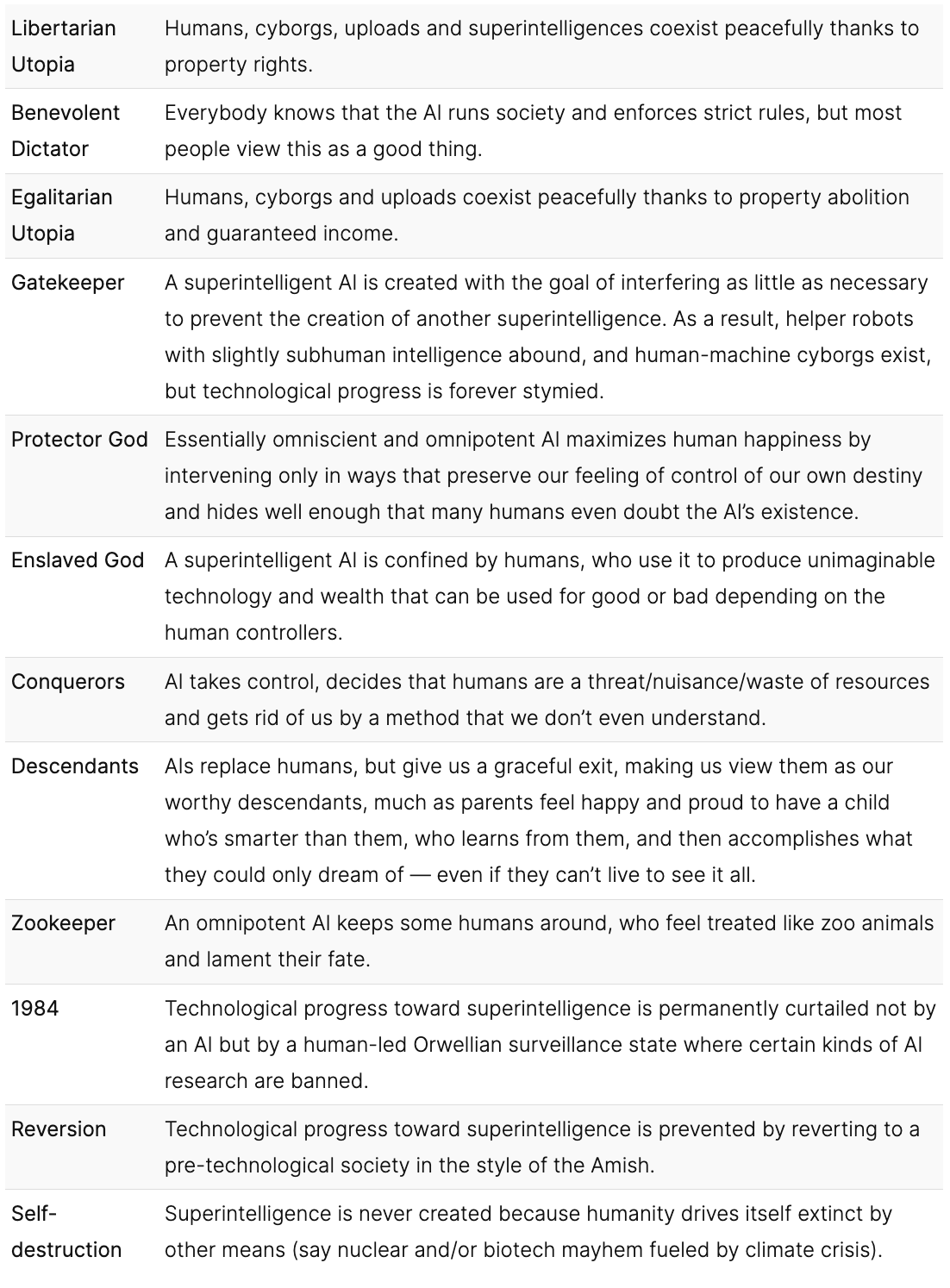
via @danielfagella